


Basic Criteria for Evaluating an Acoustic Imaging Camera
Today, there are numerous acoustic imaging cameras available for industrial applications, each with different configurations and performance specifications. However, evaluating the quality of an acoustic imaging camera requires a sound understanding of the underlying technical parameters. This article provides key information to help users assess and select the most suitable acoustic imaging camera for their application.
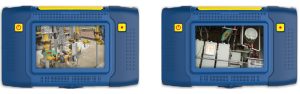
Industrial Applications of Acoustic Imaging Cameras
Acoustic imaging cameras are widely used in industrial environments for applications such as:
- Detecting leaks in compressed air, vacuum, gas, and steam systems
- Evaluating sealing integrity in shipbuilding and automotive industries
- Detecting and assessing partial discharge activity in electrical transmission systems
- Inspecting overhead transmission and distribution lines
- Monitoring transformer bushings and other high-voltage assets
Number of Microphone Channels
One of the first specifications listed in any acoustic imaging camera datasheet is the number of integrated microphone channels. This parameter is particularly important because it directly influences several key performance characteristics.
Device Sensitivity
The greater the number of microphones, the higher the sensitivity of the device. More microphones allow the camera to capture more acoustic energy from the sound source, making it easier to detect weak signals and early-stage defects.
As a result, small leakages and low-level fault signatures can be detected more effectively than with systems equipped with fewer microphones.
Most manufacturers today utilize digital MEMS (Micro-Electro-Mechanical Systems) microphones because they offer compact size, high performance, cost efficiency, and the ability to capture sound pressure levels exceeding 120 dB.
Higher sensitivity enables the detection of very small leaks, often below 0.05 L/min. This capability allows maintenance personnel to identify and manage nearly all leakage points, helping optimize maintenance planning and maximize the effectiveness of limited resources.
Both microphone count and sensitivity specifications are typically available in product datasheets and can be used as key comparison parameters when evaluating different systems.
Detection Distance
Increasing the number of microphones also improves the ability to detect weaker signals at greater distances from the source.
According to research conducted by NL Acoustics, the detection range can approximately double when the number of microphones is increased by a factor of four.
Therefore, if a manufacturer claims significantly greater detection distances without a corresponding increase in microphone count or other supporting technologies, it is advisable to request additional technical clarification.
Localization Capability
The source localization performance of an acoustic imaging camera depends on several factors, including:
- Signal acquisition capability
- Signal processing and noise suppression performance
- Internal beamforming algorithms
- Display resolution
As the distance between the camera and the sound source increases, higher display resolution becomes increasingly important to accurately pinpoint the source location.
However, the required display resolution also depends on the intended application.
For example, when inspecting overhead power lines for partial discharge activity at distances of up to 50 meters, ultra-high display resolution is generally unnecessary because the density of equipment along transmission lines is relatively low.
Therefore, the standard resolution commonly found in current acoustic imaging cameras (640 × 480 pixels) is typically sufficient for locating partial discharge sources at such distances.
Frequency Range and Sampling Rate
Another equally important specification affecting measurement accuracy is the measurable frequency range and the sampling rate.
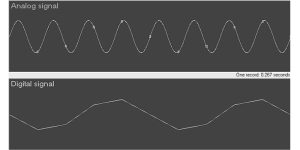
Acoustic signals are initially captured in analog form and subsequently converted into digital signals for processing and analysis. If this conversion process is not properly implemented, the resulting data may fail to accurately represent the actual condition of the equipment, potentially leading to missed detections of leaks, partial discharges, or other defects.
According to signal processing principles, the sampling frequency must be at least twice the maximum measurable frequency of the device to ensure accurate analog-to-digital conversion.
This requirement is based on the Nyquist Sampling Theorem and is essential for preserving signal integrity and preventing information loss.
For this reason, both the measurable frequency range and the sampling rate should be clearly specified in the technical documentation of the instrument.
The figure below illustrates the signal acquisition and analog-to-digital conversion process.
Signal Noise and Noise Filtering
Signal noise can also have a significant impact on measurement results. Therefore, an acoustic imaging camera should incorporate effective noise filtering techniques to ensure reliable data acquisition.
Without proper noise suppression, the measurement results may lack credibility and lead to inaccurate assessments.
Two common methods used to distinguish genuine ultrasonic signals from background noise are:
Audio Conversion with Headphones
This method converts ultrasonic signals into audible frequencies that can be monitored through headphones. By listening to the converted sound, inspectors can distinguish fault-related signals from ambient noise based on their acoustic characteristics.
Phase-Resolved Analysis
Another effective approach is the use of phase-resolved analysis or phase diagrams to identify and classify signal sources. This technique is particularly valuable for partial discharge detection, where phase information helps differentiate actual defects from external interference.
The principles and applications of phase-resolved analysis will be discussed in a future article.
Conclusion
To maximize the return on investment and ensure effective utilization of an acoustic imaging camera, users should establish clear technical evaluation criteria when comparing available solutions.
The parameters discussed above—including microphone count, sensitivity, detection range, localization capability, frequency range, sampling rate, and noise filtering performance—represent some of the most important factors influencing the performance and reliability of an acoustic imaging camera.
These criteria can serve as a practical guideline for selecting the most suitable solution for industrial inspection and condition monitoring applications.

Vpower Reliability – Dẫn đầu thị trường về các giải pháp nâng cao độ tin cậy của hệ thống điện và cơ khí, cung cấp danh mục sản phẩm và dịch vụ toàn diện, được tùy chỉnh để tối ưu độ tin cậy và quản lý tài sản trong nhiều ngành công nghiệp.